

Spirit Academy › Brandy › Brandy
Brandy
Distilled fruit, most often wine, usually rested in oak. Cognac, Armagnac, Calvados, pisco, grappa and kirsch all start here.
In one sip
Brandy is what you get when you ferment fruit and run it through a still. Most of the time the fruit is grapes, the starting liquid is wine, and the spirit then rests in oak until it turns amber and soft. Change the fruit, the still, the wood or the town, and you move across a family that runs from a Cognac XO to a clear Peruvian pisco to a cherry kirsch.
Where it started
The name is Dutch. Merchants trading on the Charente in the 16th century distilled the region's thin wines to keep them sound on the voyage north and called the result brandwijn, burnt wine, which became "brandy."4 Gascony makes an older claim for its own eau-de-vie: the Armagnac trade body cites a 1310 text by Vital Dufour, prior of Eauze, as the first evidence of its use.11 The English age codes on so many labels, VS, VSOP and XO, are a leftover of that trade: the Armagnac trade body traces them to 18th-century Anglo-Saxon merchants who owned Cognac houses.10
Where and how it's made
In the United States, brandy is any spirit distilled from the fermented juice, mash or wine of fruit, or its residue, at less than 190 proof, and bottled at not less than 80 proof.1 Unqualified, the word "brandy" on a U.S. label means grape brandy; anything else has to name its fruit, as in "peach brandy."1 Grape brandy stored in oak for less than two years has to be called "immature brandy,"1 and immature brandies are exempt from the federal rule that requires an age statement on young brandy.2 Federal rules also name foreign types, Cognac, Armagnac, Brandy de Jerez, Calvados, Pisco from Peru or Chile, and Singani from Bolivia, each of which must be made in its home country under that country's own law.1 Distill any brandy above 170 proof and it becomes "neutral brandy."1
Europe splits the same ground into several categories. Wine spirit is distilled from wine at less than 86 percent alcohol and bottled at at least 37.5 percent.3 Brandy, or Weinbrand, is wine spirit aged at least one year in oak receptacles of 1,000 liters or more, or six months in casks smaller than that, and bottled at a minimum of 36 percent.3 Grape marc spirit, fruit spirit, and cider and perry spirit each have their own rules.3
Every style uses the same two choices. A pot still works in batches and is often run twice, as in Cognac; a column still runs continuously, as in most Armagnac.9 Then comes wood, or no wood: Cognac must spend at least two years in oak, while Blanche Armagnac skips wood entirely.9
How to taste it
Use a tulip glass; Cognac's own guidance favors it because its slightly closed shape locks the aromas in.7 Nose it before you swirl, then again after. Young brandies read as fresh fruit and flowers; long-aged ones move toward dried fruit, spice and the savory note called rancio. Brandy de Jerez's regulator gives two serving temperatures: 10 to 15 °C in its serving guide5 and 17 to 18 °C, from a hand-warmed balloon, in its FAQ.6 Both pages advise against heating the glass.56 Pairings: aged Cheddar or a blue cheese, dark chocolate, a tarte Tatin.
Styles and what the label means
Words to know
Tap a term to get asked about it in The Tasting Room.
Start here — craft pours to try
Real bottles from craft makers on Tipxy.

Sources
- 27 CFR 5.145 Brandy (eCFR) accessed 2026-10-12
- 27 CFR 5.74 Statements of age, storage, and percentage (eCFR) accessed 2026-10-12
- Regulation (EU) 2019/787 on spirit drinks, Annex I (EUR-Lex) accessed 2026-10-12
- BNIC — One culture, one history accessed 2026-10-12
- Consejo Regulador Brandy de Jerez — How to serve Brandy de Jerez accessed 2026-10-12
- Consejo Regulador Brandy de Jerez — Frequently asked questions accessed 2026-10-12
- BNIC — How to taste Cognac? accessed 2026-10-12
- IDAC (Calvados appellations) — FAQ accessed 2026-10-12
- IDAC — Calvados vs Cognac vs Armagnac vs Whisky accessed 2026-10-12
- BNIA (Armagnac) — FAQ accessed 2026-10-12
- BNIA — 700 years of history accessed 2026-10-12
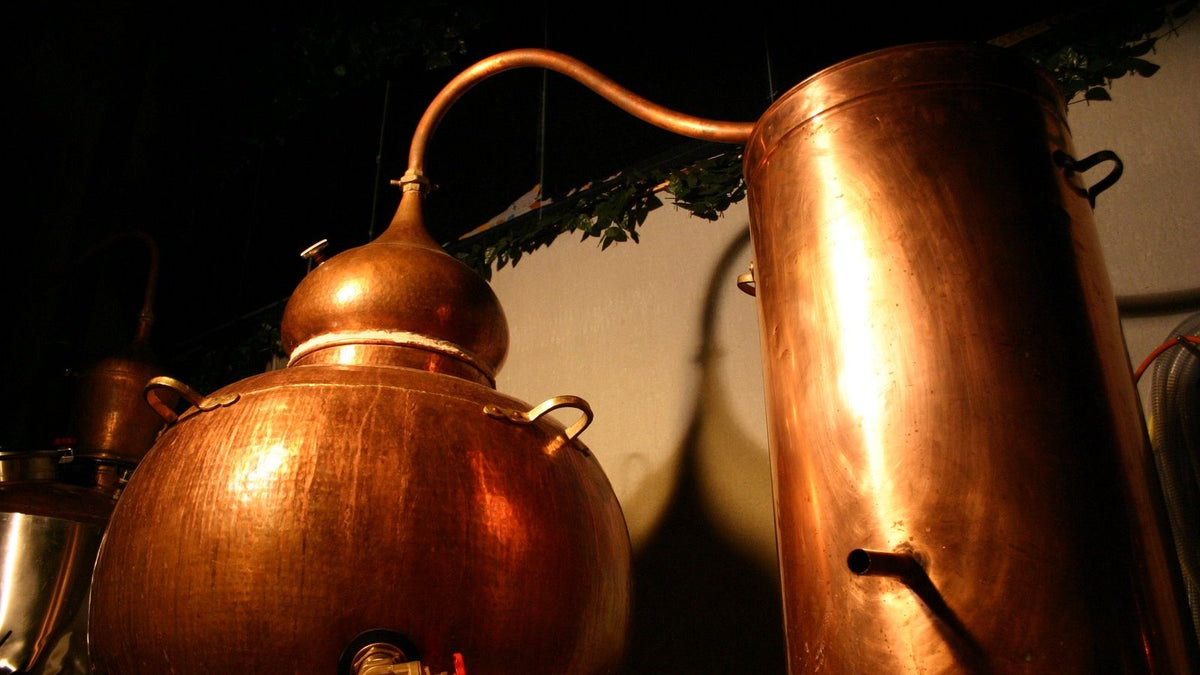
Photo: Bitterherbs1, CC BY-SA 3.0, via Wikimedia Commons