

Spirit Academy › Brandy › Cognac
Cognac
Charente wine, distilled twice in copper and aged at least two years in oak. VS, VSOP and XO are legal age codes, not marketing.
In one sip
Cognac is grape brandy from a fenced-off corner of western France, distilled twice in copper pot stills and aged in oak for at least two years before anyone may sell it. The grapes are sour and the wine is thin on purpose: that is what concentrates into a floral, fruity spirit that then spends years, sometimes decades, gaining color and depth in the barrel.
Where it started
Dutch traders distilled Charente wine in the 16th century so it would survive shipping, and double distillation appeared at the start of the 17th.5 The first Cognac house was established in 1643.5 A free trade agreement between England and France in 1860 sent sales up; around 1875 phylloxera arrived and destroyed most of the vineyard.5 The law followed: the production area was delimited on 1 May 1909, the production conditions defined on 15 May 1936, and the crus mapped on 13 January 1938.1 Cognac aged less than two years was banned from sale for consumption on 18 March 1975.1
Where and how it's made
The area covers most of Charente-Maritime, a large part of Charente and a few villages in the Dordogne and Deux-Sèvres.6 Ugni Blanc is planted in over 98 percent of the vineyard; Colombard, Folle Blanche, Montils, Sémillon and Folignan make up the rest.4 Adding sugar or sulphites during fermentation is prohibited.6
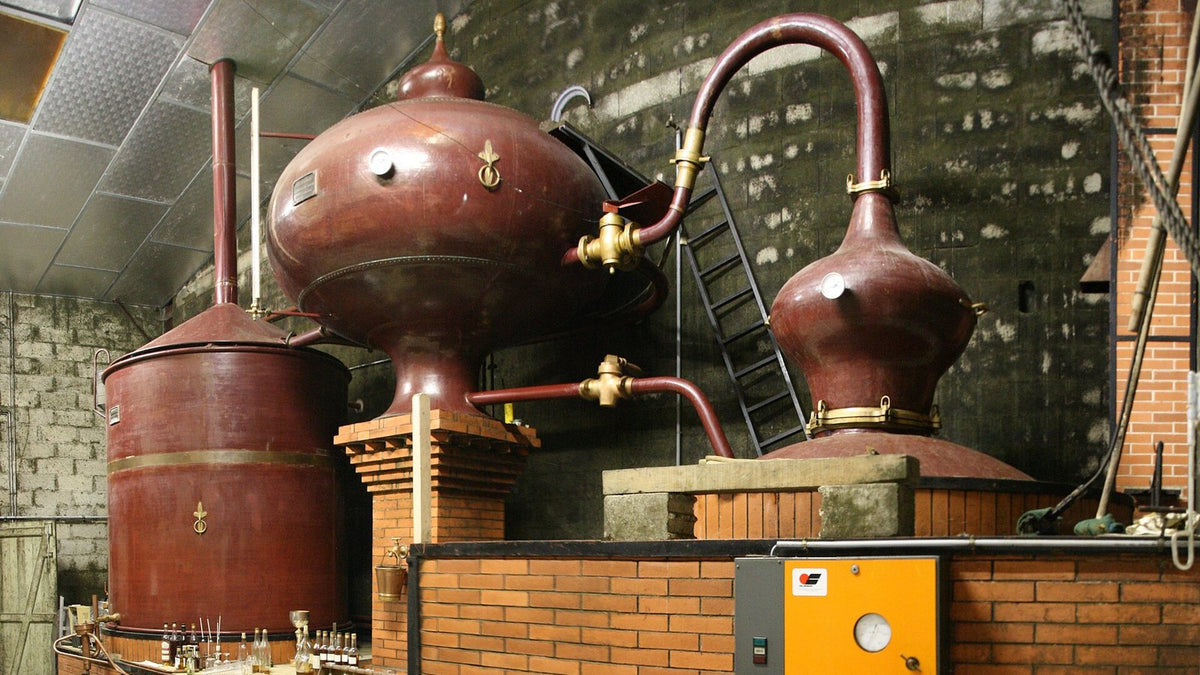
Distillation is the Charentais double distillation: a first chauffe makes the brouillis, and the second, the bonne chauffe, makes Cognac once heads and tails are cut.6 The copper boiler for the second distillation may hold no more than 30 hectoliters, charged with 25.2 Distilling must finish by 31 March after the harvest.6 The spirit then ages without interruption, exclusively in oak.1 It must reach at least 40 percent alcohol to be sold.1 By value, 96.8 percent of Cognac is consumed outside France (2025).7
How to taste it
A tulip glass, neat, nose first without swirling. Young Cognac shows vine flower, grape and pear; older Cognac moves toward candied fruit, spice and rancio. The BNIC's own pairing work matches a VSOP with extra-mature Mimolette and an XO with pigeon à l'orange; a frozen VS goes with smoked herring.8
Styles and what the label means
Age categories count the youngest spirit in the blend.1 - VS / Very Special / ★★★ — at least 2 years.1 - VSOP / Réserve — at least 4 years.1 - Napoléon / Très Vieille Réserve — at least 6 years.1 - XO / Hors d'âge — at least 10 years; the minimum rose from six years on 1 April 2018.19 - XXO / Extra Extra Old — at least 14 years.1 - The crus — Grande Champagne, Petite Champagne, Borderies, Fins Bois, Bons Bois, Bois Ordinaires; a cru on the label means 100 percent of the blend comes from it.31 - Fine Champagne — a blend of Grande Champagne (at least 50 percent) and Petite Champagne only.1
Words to know
Tap a term to get asked about it in The Tasting Room.
Start here — craft pours to try
Real bottles from craft makers on Tipxy.

Sources
- BNIC — A Geographical Indication accessed 2026-10-12
- Cognac product specification (2024, English translation, BNIC) accessed 2026-10-12
- BNIC — The various crus in the Cognac GI accessed 2026-10-12
- BNIC — Cognac grape varieties accessed 2026-10-12
- BNIC — One culture, one history accessed 2026-10-12
- BNIC — Production accessed 2026-10-12
- BNIC — Cognac in figures accessed 2026-10-12
- BNIC — Cognac-food pairings accessed 2026-10-12
- Harpers — Cognac XO age classification increases to 10 years (15 Jan 2018) accessed 2026-10-12
Photo: Sémhur, CC BY-SA 4.0, via Wikimedia Commons