

Spirit Academy › Liqueur Aperitivo › Absinthe
Absinthe
Wormwood, anise and fennel: absinthe's Swiss origins, its century-long bans, and the U.S. thujone rule that brought it back.
In one sip
Absinthe is a high-strength spirit distilled with wormwood, green anise and fennel, meant to be diluted with cold water until it clouds. It was banned in several European countries and the United States in the early 20th century, and came back once regulators set clear rules on its wormwood compound, thujone. Today it is a legal, labeled category with a long, colorful backstory.
Where it started
Absinthe's cradle is the Val-de-Travers, a Swiss valley between Neuchâtel and Pontarlier. In 1797 Daniel-Henri Dubied, his son Marcelin and son-in-law Henri-Louis Pernod founded a distillery in Couvet; eight years later Pernod opened his own factory just over the French border in Pontarlier.3 By the end of the 19th century, absinthe was the drink of Paris cafés and of painters and writers.3
The backlash was political. In Switzerland a 1908 popular vote, carried by 63.5 percent, approved a ban on distilling absinthe that took effect in 1910; Belgium had acted in 1906 and France followed in 1915, per swissinfo;3 Difford's dates those bans to 1905 and 1914/15, and adds the United States (1912) and Italy (1932).4 Switzerland lifted its ban in 2005.3
Where and how it's made
Wormwood (Artemisia absinthium) and other herbs macerate overnight in alcohol, and the next day the mix is distilled; one Val-de-Travers recipe uses wormwood, fennel, green anise, hyssop and lemon balm.3 The spirit is often sold at high strength because it is meant to be diluted.3
The U.S. rule
FDA lists Artemisia (wormwood) among natural flavoring substances allowed only if the finished food is "thujone free".2 TTB's 2007 industry circular, still posted in its archive and written before the 2022 renumbering of the labeling rules, sets the working number: it considers a product thujone-free if it contains less than 10 parts per million of thujone.1 Producers and importers using wormwood must send a 750 millilitre sample to TTB's laboratory before seeking label approval.1
How to taste it
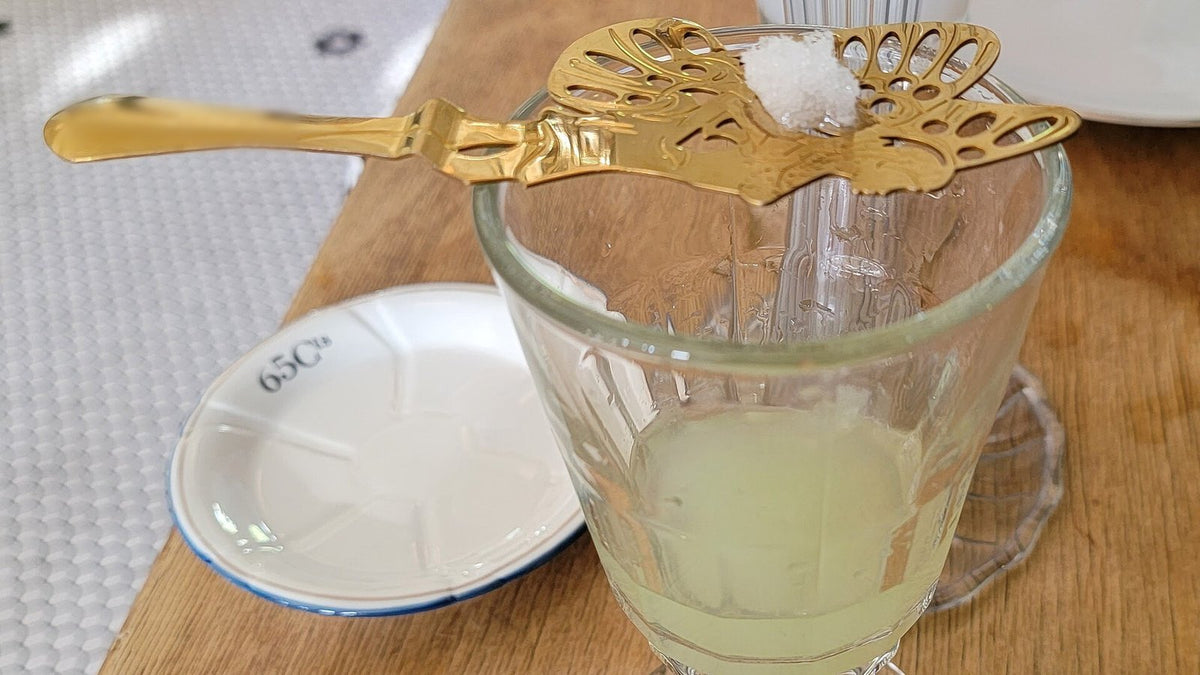
Pour a small measure into a stemmed glass and slowly add ice-cold water, ideally drop by drop, until it louches into an opal cloud. Sugar is optional. Smell for anise first, then the bitter-green wormwood underneath. Pairings: oysters, goat cheese, dark chocolate.
Styles and what the label means
- Verte — green absinthe, colored traditionally by herbs.
- Blanche — clear, uncolored absinthe.
- La Bleue — the Val-de-Travers nickname for absinthe, probably from the bluish hue it takes when water is added.3
- "Absinthe" on a U.S. label — always paired with other words, and thujone-free under 10 ppm.1
- Pastis — the anise aperitif that filled the gap after the bans. anise-sambuca-ouzo-arak →
Words to know
Tap a term to get asked about it in The Tasting Room.
Sources
- TTB Industry Circular 2007-5 — Use of the Term Absinthe for Distilled Spirits accessed 2026-10-12
- 21 CFR 172.510 Natural flavoring substances (eCFR) accessed 2026-10-12
- swissinfo.ch — Absinthe: the return of the green fairy (May 2025) accessed 2026-10-12
- Difford's Guide — History of vermouth accessed 2026-10-12
Photo: Викидим, CC BY-SA 4.0, via Wikimedia Commons