

Spirit Academy › Cane › Overproof and Navy Rum
Overproof and Navy Rum
High-strength rum, the proof systems behind it, and the Royal Navy rum ration that ended on Black Tot Day, 1970.
In one sip
Overproof rum is rum bottled well above the usual 40 percent; navy rum is a dark, heavy style that borrows its name from the Royal Navy's daily ration. Both are strong enough that a few drops of water change everything, and both come with stories worth knowing.
Where it started
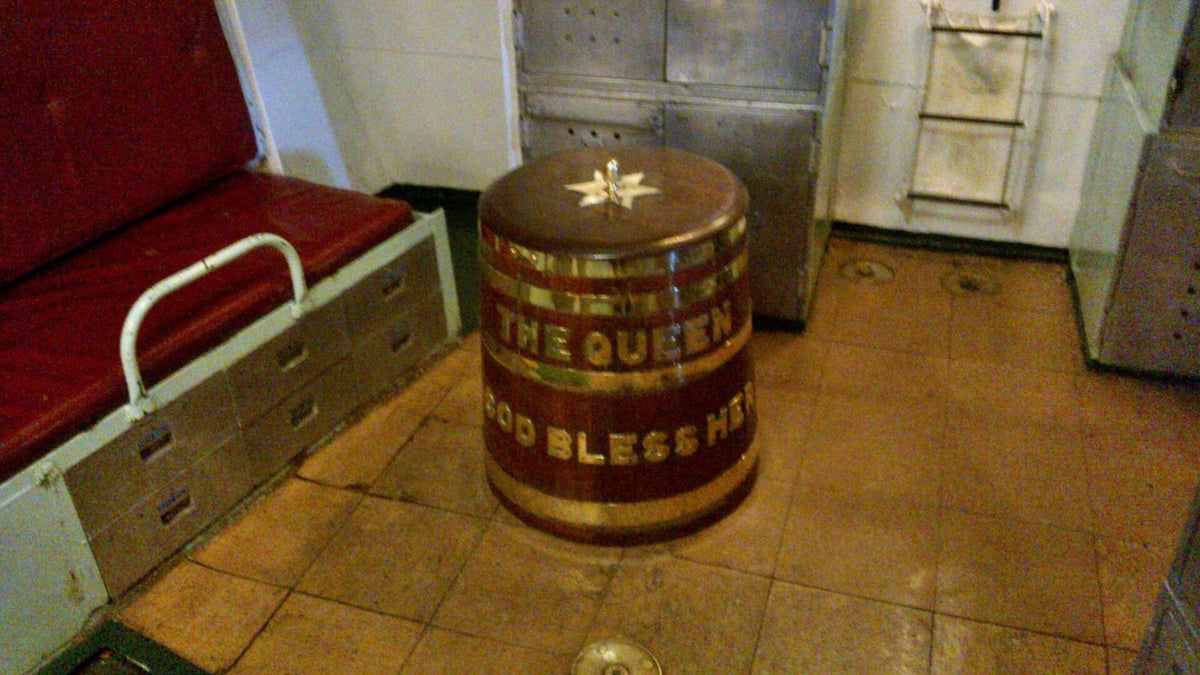
The Royal Navy's link with rum is usually traced to 1655 and Vice-Admiral William Penn's expedition, which took Jamaica.3 Regulations in 1731 officially recognized rum as a substitute for beer in the West Indies.3 On August 21, 1740, Admiral Edward Vernon issued Order to Captains No. 349, requiring the rum to be diluted with water; his nickname, "Old Grogram," after his grogram cloak, gave the mixture its name, grog.3 Grog was issued from a scuttled butt, an open cask on deck, and the talk around it turned "scuttlebutt" into a word for gossip.3 The ration was called Pusser's rum, a corruption of "purser," the officer who issued it.5 On December 17, 1969 the Admiralty decided to end it, and the final tot was poured on July 31, 1970, Black Tot Day.5 Some sailors wore black armbands that day.5
Where and how it's made
Before accurate hydrometers, legend says pursers mixed rum with gunpowder and lit it: if it just ignited, it was proof; too weak and it would not light.2 In 1816 Bartholomew Sikes invented a hydrometer that set British 100 proof at just over 57 percent alcohol, adopted into law in 1818.2 The UK replaced the Sikes scale with alcohol by volume on January 1, 1980.2
The U.S. system is simpler: proof is twice the percentage of alcohol by volume, measured at 60°F.1 So 50 percent is 100 U.S. proof, and Difford's treats any rum above 50 percent as overproof.2
"Navy Strength" is murkier than it sounds. Difford's argues the Navy's own standard worked out to 54.5 percent and that bottles labeled Navy Strength at 57 percent have confused English proof with Navy Strength.2 By 1810 the Admiralty had approved a consistent blend drawn from Guyana, Jamaica, Barbados and Trinidad, with Guyana supplying the bulk of the pot-still rum.3 Naval rum today has no legal definition, but suggests a dark, strong, heavy style blended from several countries.4
How to taste it
Pour a small measure into a tulip glass and add water a few drops at a time; overproof rum opens up as it is diluted. Expect concentrated molasses, tropical fruit and esters. These rums are mostly cocktail ingredients: a measured float or a split base in a tiki drink. Pairings: smoked meats, spiced nuts, bread pudding.
Styles and what the label means
- Overproof — any rum above 50 percent ABV, often white and unaged.2
- Navy Strength — commonly 57 percent; Difford's places the historic standard at 54.5.2
- Navy-style blend — dark, heavy rum blended from several Caribbean sources.4
- Barrel proof — high-strength aged rum bottled near cask strength.4
- Demerara — the Guyanese backbone of the old navy blend. dark-and-blackstrap-rum →
Words to know
Tap a term to get asked about it in The Tasting Room.
Start here — craft pours to try
Real bottles from craft makers on Tipxy.


Sources
- 27 CFR 5.1 Definitions (eCFR) accessed 2026-10-12
- Difford's Guide — Overproof & Navy Strength accessed 2026-10-12
- Difford's Guide — Navy Rum: the rum that fuelled the British Navy accessed 2026-10-12
- Difford's Guide — Rum: Lexicon of rum terms accessed 2026-10-12
- Royal Museums Greenwich — A rum deal: the origins of Nelson's blood accessed 2026-10-12
Photo: Hammersfan, CC BY-SA 3.0, via Wikimedia Commons