

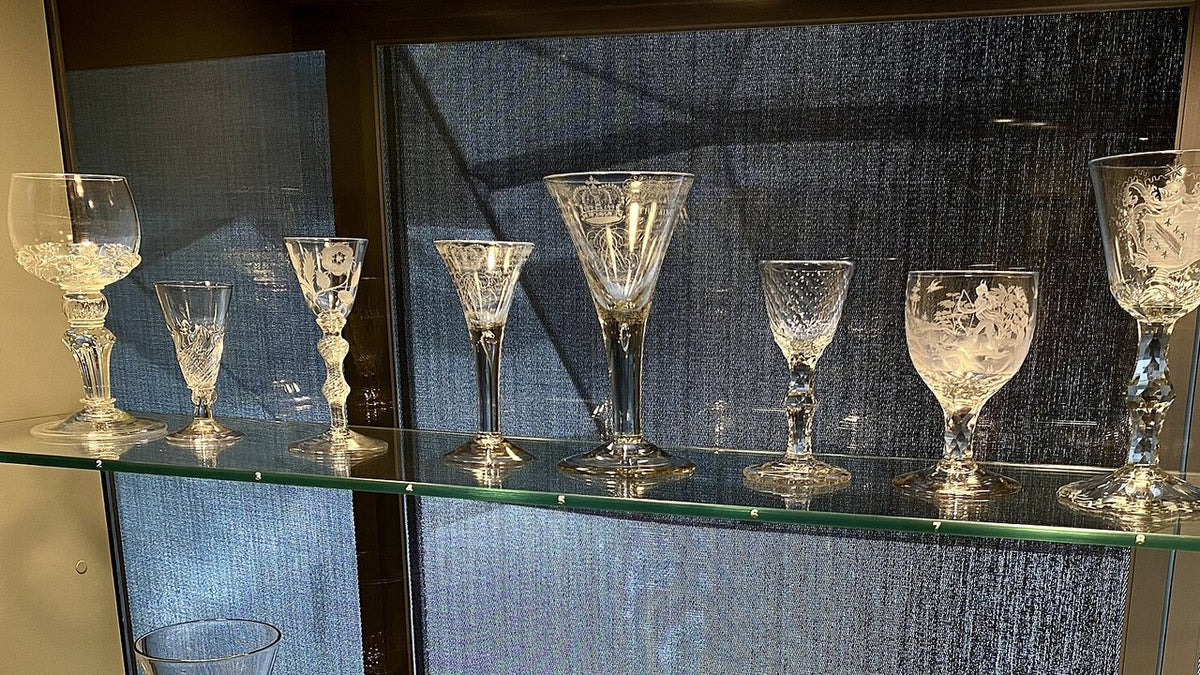
Spirit Academy › Bar Craft › Glassware
Glassware
Why a Martini gets a stem, an Old-Fashioned gets a heavy base, and a whisky nosing glass narrows at the top. The working shapes behind the bar.
In one sip
A glass has three jobs: keep the drink at the right temperature, show it off, and deliver its aroma to your nose. Stems keep warm hands off cold drinks. Narrow rims gather aroma. Heavy bases survive ice, muddling and the occasional bump on the bar.
Where it started
Early American bars got by with very few shapes. The "small bar glass," heavy-bottomed, slant-sided and holding five or six ounces, was used both to mix and to serve short drinks, and Jerry Thomas specified it in 1862 for smashes, slings, toddies and cocktails.1 Once bartenders began straining iced drinks, a stem was needed so the drinker's hand would not warm the drink, and by the early 1870s recipes called for a "cocktail glass" by name.2
The V-shaped icon descends from a champagne coupe designed by the Austrian architect Oswald Haerdtl for J & L Lobmeyr and shown at the 1925 Paris Exposition; by Repeal in 1933 it was the fashionable cocktail glass.2
Wine and whisky glasses became design projects later. Riedel credits Claus J. Riedel with a design revolution in 1958 and dates its Sommeliers line to 1973, which it calls the world's first wine glass collection shaped for wine enjoyment; that "first in history" framing is the company's own marketing claim.9 The Glencairn whisky glass, modeled on the sherry copita, launched in 2001; Glencairn says Scotch master blenders guided its final shape.10
Where and how it's made
Cocktail glass or coupe. Early cocktail glasses held 75 to 90 ml. Spillage worries and customer expectations pushed sizes up until, by 1939, "double Martini" glasses held 180 to 240 ml; the cocktail renaissance brought the norm back to about 150 ml.2
Sour glass. Stemmed like the cocktail glass but larger, about 150 ml against 90 ml, to fit the citrus juice and water of a sour.5
Rocks or Old-Fashioned glass. A short, heavy-bottomed tumbler, called the small bar glass in the nineteenth century.3 "On-the-rocks glass" was shortened to "rocks glass" by the mid-1970s.4
Highball or Collins. Tall glasses for long drinks over ice, the home of the Tom Collins, Gin and Tonic and Cuba Libre.8
Nosing glass. The copita, based on the Spanish glass used to sample sherry, concentrates aromas through a slightly narrowed rim; the Glencairn's tulip shape lets aromas collect inside the glass.11
How to taste it
Chill stemmed cocktail glasses before you strain into them, and hold any stemmed glass by the stem. For tasting, choose a bowl that narrows toward the rim and pour small. Taittinger suggests filling champagne glasses two-thirds full so aromas can develop.12 Pairings for a glassware evening: a coupe of brut with salted crisps, a rocks glass of rye with walnuts.
Styles and what the label means
- Champagne flute versus tulip — Taittinger says tall flutes are not ideal for champagne and recommends coupes, white wine glasses or tulip glasses.12 food-pairing-and-serving →
- Julep cup — the IBA builds its Mint Julep in a stainless steel julep cup.13
- Mule cup — the IBA allows a mule cup or a rocks glass for the Moscow Mule.14
- Irish coffee glass — preheated before the coffee goes in.15
- Pony — a small stemmed cordial glass of 20 to 30 ml, later a measure.6
- Matching glass to drink cocktail-families →
Words to know
Tap a term to get asked about it in The Tasting Room.
Start here — craft pours to try
Real bottles from craft makers on Tipxy.
Sources
- Oxford Companion to Spirits & Cocktails — glassware accessed 2026-10-12
- Oxford Companion to Spirits & Cocktails — glass, cocktail accessed 2026-10-12
- Oxford Companion to Spirits & Cocktails — glass, Old-Fashioned accessed 2026-10-12
- Oxford Companion to Spirits & Cocktails — rocks accessed 2026-10-12
- Oxford Companion to Spirits & Cocktails — The sour accessed 2026-10-12
- Oxford Companion to Spirits & Cocktails — pony glass accessed 2026-10-12
- Oxford Companion to Spirits & Cocktails — A wineglass accessed 2026-10-12
- Oxford Companion to Spirits & Cocktails — long drink accessed 2026-10-12
- RIEDEL — Sommeliers collection (producer page) accessed 2026-10-12
- Glencairn Crystal — The Glencairn Glass (producer page) accessed 2026-10-12
- Scotch Whisky Association — Scotch Whisky Tasting Toolkit (2020) accessed 2026-10-12
- Champagne Taittinger — How to serve and enjoy champagne (producer page) accessed 2026-10-12
- IBA — Mint Julep accessed 2026-10-12
- IBA — Moscow Mule accessed 2026-10-12
- IBA — Irish Coffee accessed 2026-10-12
Photo: Andre Carrotflower, CC BY-SA 4.0, via Wikimedia Commons